


Dirty pond water affects shrimp ponds
In modern shrimp farming, pond water quality plays a critical role in determining survival rate, growth performance, and the overall profitability of the production cycle. However, many farmers still face common challenges such as unstable water color, organic sludge accumulation on the pond bottom, and elevated levels of toxic gases. These conditions can cause shrimp to grow slowly, become more susceptible to disease, and suffer prolonged mortality losses.
In many shrimp ponds, crop failures are not caused by disease outbreaks at the beginning of the production cycle. Instead, the root cause is often prolonged water pollution that is not treated in time.
So, how does poor water quality affect shrimp? What are the underlying causes, and which solutions can effectively and safely restore pond water conditions? Let’s explore these questions in detail in the article below.

Dirty pond water affects shrimp?
I. Causes of Poor Water Quality in Shrimp Ponds
During the culture period, organic matter and toxic gases continuously accumulate in shrimp ponds. If not properly managed, pond water quality can deteriorate rapidly, negatively affecting shrimp health and growth.
Some common causes of poor water quality in shrimp ponds include:
- Accumulation of uneaten feed
- When feed is overapplied or shrimp have a weak appetite, uneaten feed settles to the pond bottom and decomposes, generating toxic gases such as ammonia (NH₃), nitrite (NO₂⁻), and hydrogen sulfide (H₂S).
- High levels of shrimp waste and organic sludge
- The higher the stocking density, the greater the volume of waste produced. Over time, a layer of black sludge forms on the pond bottom, harboring large populations of harmful bacteria.
- Algal die-off and ecosystem imbalance
- Unstable weather conditions, especially alternating hot and rainy periods, can cause fluctuations in algal growth. When algae collapse suddenly, the water becomes turbid, dissolved oxygen drops, and toxic metabolites accumulate.
- Decline of beneficial microbial populations
- Ponds lacking sufficient probiotic bacteria for bottom treatment are prone to excessive organic matter buildup, leading to rapid deterioration of water and sediment quality.
Without the regular application of beneficial bottom-cleaning probiotics, organic matter will accumulate progressively in the pond, causing water quality and overall pond conditions to deteriorate rapidly.
II. Consequences of Poor Water Quality in Shrimp Ponds
Many shrimp farmers assume that problems only become serious when shrimp start dying. In reality, poor water quality often has a silent but long-lasting impact, gradually weakening the shrimp over time.
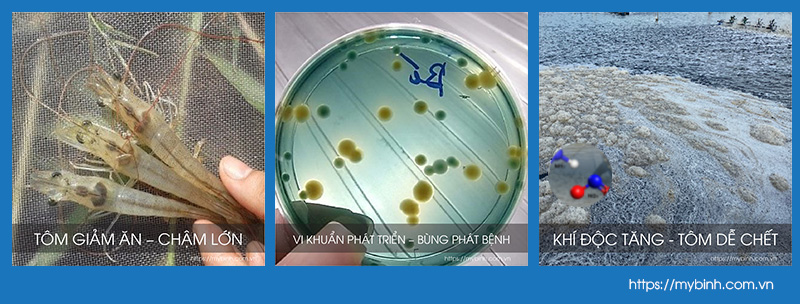
Higher feed conversion ratio (FCR)
1. Reduced Feed Intake and Slow Growth
This is one of the earliest and most noticeable signs when pond water becomes polluted.
As toxic gases such as ammonia (NH₃), nitrite (NO₂⁻), and hydrogen sulfide (H₂S) accumulate, shrimp often show the following symptoms:
- Reduced appetite and poor feed consumption
- Empty gut or broken gut contents
- Higher feed conversion ratio (FCR)
- Slow growth
- Uneven size distribution
These issues extend the culture period and significantly increase feed costs.
2. Stress, Surface Swimming, and Increased Mortality
When the pond bottom is heavily polluted, dissolved oxygen (DO) levels drop sharply, especially at night, while toxic gases are continuously released from the sludge layer.
Shrimp may exhibit:
- Lethargic swimming behavior
- Congregation around aerators
- Surface swimming in the early morning
- Sporadic mortality after rainfall or during the night
If these warning signs are not detected and addressed promptly, mortality can increase rapidly within just a few days.
3. Rapid Proliferation of Harmful Bacteria
Dirty pond water creates ideal conditions for the growth of pathogenic bacteria, particularly Vibrio spp., as well as other disease-causing microorganisms.
This can lead to common shrimp diseases and health problems such as:
- White feces syndrome (WFS)
- Muscle necrosis and body curvature
- Fouling and excessive algal attachment
- Soft shell
- Hepatopancreatic necrosis
Once disease outbreaks occur, treatment costs rise substantially, while recovery results are often unpredictable.
4. Severe Deterioration of Pond Bottom Conditions
Long-term accumulation of organic sludge causes serious pond bottom degradation, characterized by:
- Black pond bottom
- Foul and fishy odors
- Thick organic sludge
- Continuous gas bubbles rising from the sediment
These are clear indicators that the pond environment is heavily polluted and requires immediate remediation.
III. Why Is Poor Water Quality the “Silent Enemy” of Shrimp Farmers?
The most dangerous aspect of poor water quality is that shrimp do not die immediately—they gradually become weaker day by day.
At the early stage, farmers may only notice:
- Shrimp feed more slowly.
- Feed consumption becomes less efficient.
- Water appears slightly turbid or has a mild unpleasant odor.
However, if this condition persists:
- Shrimp immunity declines.
- Mortality rates gradually increase.
- Disease outbreaks become more likely, especially when weather conditions change suddenly.
By the time the problem becomes clearly visible, the pond environment is often already seriously deteriorated, making corrective actions more difficult and significantly more expensive.
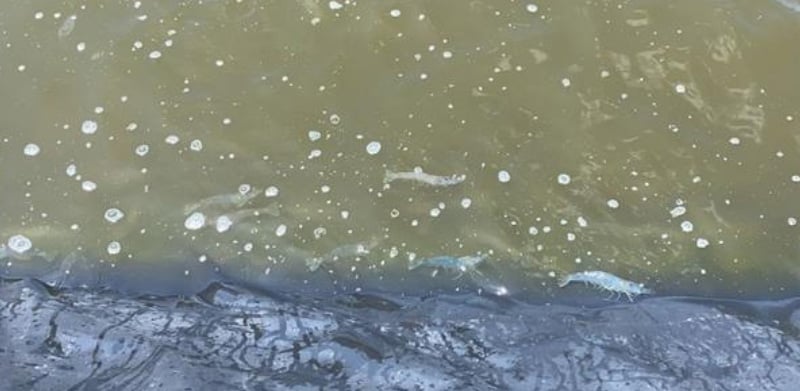
Shrimp Become Lethargic and Gather Along Pond Edges Due to Poor Water Quality
IV. Effective Solution for Treating Poor Pond Water Quality with ECO BLUE Probiotics
To minimize water quality deterioration and maintain a healthy pond environment, farmers should:
- Manage feed input properly to avoid excess organic waste.
- Increase aeration to maintain adequate dissolved oxygen levels.
- Remove sludge from the pond bottom on a regular basis.
- Apply probiotics routinely to treat both pond water and bottom sediment.
One of the probiotic solutions widely trusted by shrimp farmers today is ECO BLUE Probiotics.
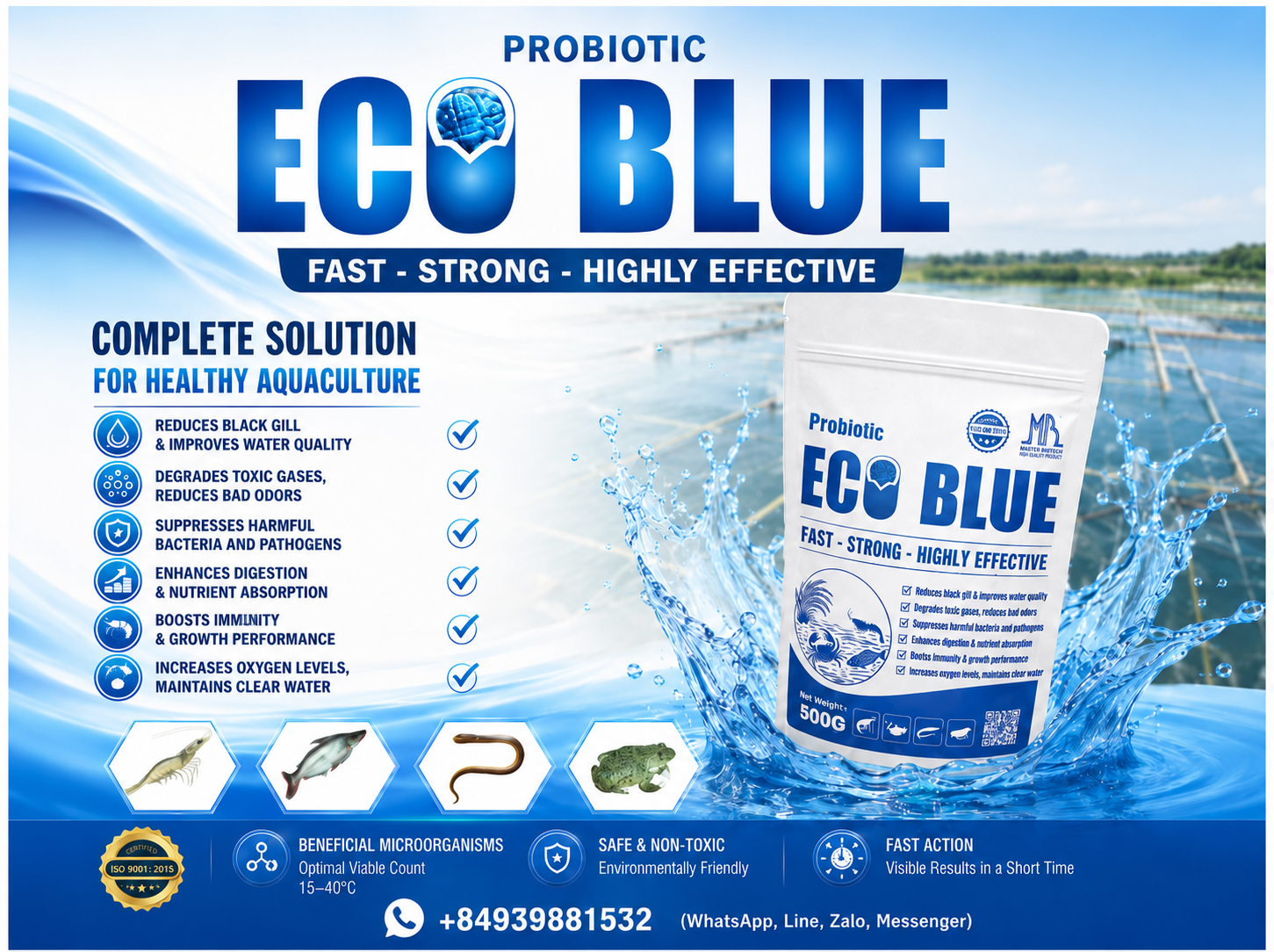
ECO BLUE Probiotic – Water and Pond Bottom Treatment for Shrimp Farming
ECO BLUE Probiotic – An Effective Solution for Cleaner Aquaculture Ponds
ECO BLUE is a specialized probiotic product for aquaculture ponds, designed to improve water quality and maintain a healthier pond bottom environment.
Key Benefits of ECO BLUE
✅ Helps decompose black sludge and accumulated organic matter on the pond bottom
✅ Reduces toxic gases such as NH₃ (ammonia), NO₂⁻ (nitrite), and H₂S (hydrogen sulfide)
✅ Supports water clarification and improves overall water quality
✅ Minimizes foul odors from the pond bottom
✅ Helps suppress the growth of harmful bacteria
✅ Supports a more stable pond environment throughout the culture cycle
Advantages of ECO BLUE
- Powerful Beneficial Microorganisms: ECO BLUE contains selected beneficial bacteria that actively accelerate the breakdown of organic waste and sludge.
- Safe for Shrimp and the Environment: Environmentally friendly and suitable for regular application throughout the shrimp production cycle.
- Fast and Visible Results: When applied correctly, ECO BLUE helps improve water quality, reduce sludge buildup, and lower toxic gas levels within a short period.
- Why Pond Water Quality Matters: Poor water quality is one of the leading causes of slow growth, disease outbreaks, and mortality in shrimp farming. If pond bottom sludge and toxic gases are not properly managed, production costs increase and farm performance can be significantly affected.
For this reason, farmers should proactively manage pond conditions from the beginning of the crop, with particular attention to controlling organic sludge and toxic gases using appropriate probiotic solutions.
ECO BLUE – A Reliable Biological Solution
ECO BLUE helps clean pond water, reduce toxic gases, and stabilize the pond environment, giving shrimp farmers greater confidence throughout the culture cycle.
MY BINH IMPORT EXPORT TRADING CO., LTD.
📱 WhatsApp / Line / Zalo / Messenger: +84 939 881 532
🌐 Product Information: Contact us for detailed specifications and technical guidance.
🏢 Head Office: 49/11B Tran Hoang Na Street, Tan An Ward, Can Tho City, Vietnam
🏭 Manufacturing Plant: 28T Nguyen Van Quy Street, Hung Phu Ward, Can Tho City, Vietnam